

Temple Structures
Collectively referred to as a Wat, Thai temples are synthesis of Theravada Buddhist cosmology, local culture, and external influences. It is a complex containing spaces for religious ritual, teaching, monastic residence, community activity and the commemoration of Buddhist and royal traditions.
Traditionally, the complex can broadly be understood through two principal zones:
Buddhavasa – the sacred area associated primarily with Buddha images and ritual buildings.
Sanghavasa – the residential and functional area associated with the monastic community.
Ubosot
The ubosot also called the uposatha hall, is the principal building for formal monastic ceremonies, especially the uposatha rites of the Sangha. It is therefore more accurately understood as an ordination and ritual hall rather than simply "the main temple". One of its most important architectural markers is the presence of sema boundary stones (bai sema), which define the consecrated ritual area. These may be positioned around the building or incorporated into more elaborate boundary arrangements. The ubosot often contains the principal Buddha image, but this is not an absolute rule. Its architectural importance derives from its ritual function.
Viharn
The viharn is an assembly or preaching hall. Unlike the ubosot, which is primarily associated with formal monastic ritual, the viharn is generally a more accessible space for monks and laypeople. It may house an important Buddha image and accommodate worship, sermons, festivals and community gatherings. This distinction becomes particularly important in understanding historical development: in some periods and temple complexes, the viharn is visually and spatially more prominent than the ubosot.
Chedi
The chedi is the Thai term commonly used for a Buddhist stupa. It is fundamentally a commemorative and reliquary monument rather than a hall intended for congregational occupation. Its forms vary considerably.
Sukhothai is particularly associated with the elegant bell-shaped stupa influenced by Sri Lankan Buddhist traditions. Ayutthaya developed several forms, including the distinctive chedi and prang, while later Rattanakosin architecture revived, refined and combined earlier forms. The chedi is therefore one of the clearest architectural indicators of historical change.
Prang
The prang is a tower form derived from the broader Khmer architectural tradition. It became especially prominent in Ayutthaya and was subsequently incorporated into Bangkok architecture. The form can be understood as a vertical architectural statement, often associated with sacred power and cosmological symbolism. In Ayutthaya, the prang evolved from large Khmer-derived forms into slender towers.
Sala
A sala is an open-sided pavilion used for a wide range of activities. It can function as a resting place, preaching pavilion, meeting space, ceremonial shelter or community gathering area. Unlike the ubosot and viharn, the sala is not defined primarily by a single highly specific Buddhist ritual function. Its openness makes it particularly important in understanding the relationship between temple and community.
Other Elements
A temple complex may also include:
Kuti – monks' residential quarters
Ho Trai – scripture library
Cloisters – covered galleries surrounding courtyards or sacred areas
Mondop – square or cruciform sacred structure, often housing a text, footprint or Buddha image
Ho Rakang – bell tower
Sathaan Phra Phuttha – structures or spaces associated with Buddha images
Gates and walls – defining thresholds and sacred boundaries
Cremation structures – particularly important in later community temples

Exterior Architecture
Thai Buddhist temple architecture is instantly recognizable for its multi-tiered, steeply sloped roofs, gilded ornamentation, and intricate carvings, which combine aesthetic brilliance with spiritual symbolism. Features such as chofah finials, bai raka ridges, and sema stones are uniquely Thai, reflecting both the country’s Buddhist cosmology and its rich tradition of craftsmanship.
The main halls of a Thai Buddhist temple - the viharn (assembly hall) and the ubosot (ordination hall), together define the temple’s exterior presence, each reflecting both functional design and sacred symbolism. Both are typically rectangular and raised on platforms, with steep, multi-tiered roofs that create a sense of verticality and grandeur. While the viharn is generally larger and more open to welcome worshippers, the ubosot is smaller, more enclosed, and highly ornamented to emphasize its ritual sanctity. Surrounding these halls, sema stones mark sacred boundaries, with those around the ubosot strictly observed during ordination rituals, highlighting the hall’s elevated spiritual status. Walls, windows, and doors are decorated with intricate carvings, gilded wood, or painted motifs, often depicting floral patterns, mythical creatures, or Buddhist symbols, blending protection, beauty, and meaning into the architecture.
A defining feature of both halls is their elaborately decorated roofs, which are not only visually striking but deeply symbolic. Chofah finials shaped like stylized birds or Garuda rise from the gable tips, believed to ward off evil spirits, while bai raka, the serpentine ridges along the eaves, represent the protective Nāga. The elegantly curving hang hong at the roof ends adds a sense of motion and spiritual ascent. These elements, often gilded or brightly colored, reflect both the craftsmanship of Thai artisans and the spiritual symbolism of enlightenment rising above the mundane. The tiered design conveys hierarchy: more tiers typically indicate higher status, royal patronage, or greater significance.
Beyond symbolism, the roofs serve practical purposes, designed for Thailand’s tropical climate. Their steep slopes allow heavy rains to drain quickly, while extended eaves provide shade and shelter to worshippers below. Together with surrounding structures such as chedi and sala, the multi-tiered roofs create a visually cohesive ensemble, harmonizing with the halls’ raised platforms, decorative walls, and sacred boundaries. In essence, the exterior of the viharn and ubosot—through form, ornamentation, and symbolic detailing—expresses the temple’s spiritual hierarchy, ritual function, and artistic mastery, making it immediately recognizable as the heart of Thai Buddhist religious life.
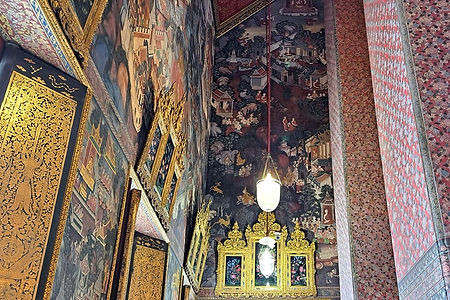
Interior Design
The interior of a Thai Buddhist temple is carefully organized to guide worshippers and monks through a spiritual journey, reflecting both practical function and symbolic meaning. Central to the layout is the main Buddha image, often placed on an elevated pedestal at the far end of the viharn or ubosot, creating a focal point for meditation, prayer, and ritual.
A hallmark of Thai temple interiors is the extensive use of murals, which line the walls and ceilings. These murals depict stories from the Jataka tales (the Buddha’s past lives), Buddhist cosmology, and local legends, combining narrative and decorative artistry. The colors are vivid, often with gold leaf accents, creating a luminous effect that enhances the sense of sacred space. The ceiling may feature painted celestial motifs, mythical creatures, or geometric patterns, emphasizing the temple as a microcosm of the universe and a bridge between the earthly and the divine.
Complementing the murals are statues, icons, and ritual objects that reinforce spiritual teachings and serve protective or devotional functions. Guardian figures may flank entrances, while smaller Buddha statues, votive images, and relic containers fill niches and altars throughout the hall. Sacred symbols, such as lotus motifs, dharmachakras (wheel of Dharma), and mythical animals, are incorporated into woodwork, pedestals, and decorative panels, creating a cohesive visual language of devotion. Together, the layout, murals, and sacred icons transform the temple interior into a living spiritual environment, where worship, meditation, and contemplation are inspired and enhanced through art, architecture and symbolism.

Thai Deities
In many Thai Buddhist temples, certain deities and spiritual figures occupy a special place, reflecting a uniquely Thai blend of Buddhism, local folklore, and guardian powers rooted in nature. This reflects a syncretic belief system that allows temples to serve as both centers religious devotion and spaces where cosmic, natural, and moral forces are acknowledged and harmonized.
Prominent deites seen include Thao Wessuwanis - guardian deity of wealth and protector against evil, often depicted holding a mace and standing near entrances to ward off malevolent spirits. Phra Rahu - a celestial deity associated with eclipses and cosmic influence, is believed to have the power to absorb misfortune, and images of Rahu are frequently displayed in temples and shrines to avert bad luck.
Other figures combine asceticism with spiritual guidance. Phra Ruesi (the hermit sage) represents meditation, wisdom, and longevity, often portrayed in forested postures or with a long beard, and is invoked for health, knowledge, and protection. Nang Kwak - a female spirit of prosperity and fortune, is commonly found at the entrance of shops or temple halls, raising a hand in a beckoning gesture to attract wealth and good business. Phra Mae Thorani - the Earth goddess, holds a central role in Buddhist cosmology in Thailand; she is famously depicted wringing water from her hair to drown Mara’s armies.
Together, these figures illustrate the distinctively Thai integration of Buddhist teachings with local spiritual beliefs, where deities serve both protective and auspicious functions. Their presence in temples through statues, murals, and ritual placement, creates a visual and symbolic reinforcement that connects devotees with the spiritual forces believed to govern both the physical and metaphysical world.

Hermit Sages
In Thai Buddhism, Phra Reusi (hermit sages) represent a unique strand of spiritual authority that exists alongside the monastic Sangha. They are often depicted as ascetics dwelling in forests or mountains, possessing ancient wisdom, mastery of meditation, and esoteric knowledge. Often referred to as Phor Gae (“Living Grandpa”), they are seen as ancestral figures who protect and transmit the lineage of sacred knowledge.
Phra Reusi are revered because they are associated with supernatural abilities, including healing, protection, alchemy, and mastery of sacred knowledge such as mantras and yantra diagrams. Many Thais believe these hermit sages accumulated immense barami through lifetimes of austerity and meditation, granting them access to hidden realms of power. As a result, they are invoked in rituals for protection, success, and spiritual guidance, much like revered monks. While not part of the formal monastic hierarchy, they are deeply respected as cultural heroes, bridging Buddhism with older Brahmanical and animist traditions.
The reverence for Phra Reusi is expressed through a wide range of devotional practices. Statues and images of hermit sages—often shown with long beards, tiger skins, and staffs—are found in temples, shrines, and even private homes. Practitioners of traditional arts such as medicine, martial arts, dance, and others, pay homage to them as ancestral masters. Ceremonies may include offerings of incense, flowers, and recitations to invite their blessings. In some temples, dedicated shrines to Phra Reusi exist alongside Buddha images, highlighting their role as transmitters of sacred knowledge.