
Ang Thong


Maharat Buddhist Park
Located in Maha Rat District, just across the border from Ang Thong in Phra Nakhon Si Ayutthaya, this contemporary Buddhist pilgrimage landscape is centred on a monumental image of Luang Pu Thuat, one of Thailand's most revered Buddhist monks. The site reflects the enduring Thai tradition of venerating highly respected monks through sacred images and large-scale religious monuments. Visitors can see the enormous seated image set within an expansive landscaped park, together with other devotional sculptures and spaces for merit-making and prayer. Its artistic value lies in the sheer scale of its contemporary Buddhist sculpture and the way the park combines religious devotion, monumental art and landscaped space, providing an introduction to the living Buddhist culture of the Ayutthaya–Ang Thong region.
Wat Chaiyo Worawihan
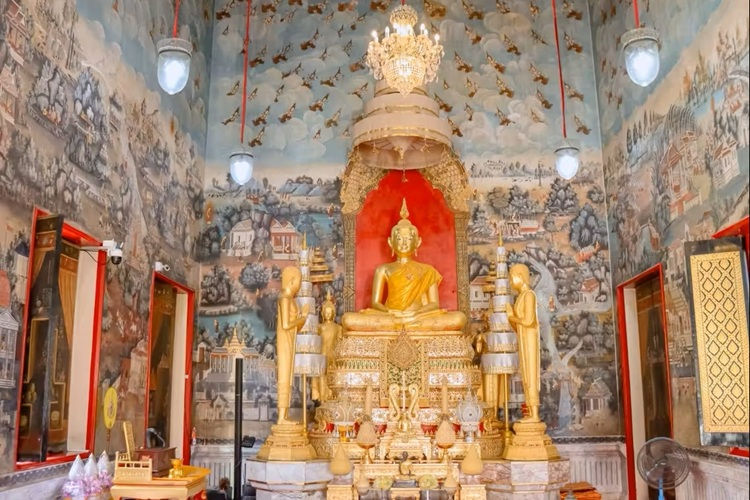
A Second-Class Royal Temple, this is arguably Ang Thong's most important temple in terms of religious status and historical significance. Although traditionally associated with the Ayutthaya period, its greatest development came during the early Rattanakosin era and particularly through its association with Somdet Phra Phutthachan (To Phrommarangsi), one of Thailand's most revered Buddhist monks. The principal attraction is Luang Pho To, a monumental seated Buddha image that became an important object of popular devotion and received royal attention during the reign of King Rama V. Visitors can also appreciate historic murals and the architectural character of a royal Buddhist monastery.
Wat Khun Inthapramun
Traditionally dated to the Sukhothai period, this is one of Ang Thong's most significant ancient Buddhist monuments. Its most remarkable feature is Phra Si Mueang Thong, a magnificent reclining Buddha approximately 50 metres long, which remains outdoors after the original vihara that sheltered it was destroyed. The reclining posture represents the Buddha's parinirvana, giving the monument both artistic and doctrinal significance. Visitors can see the enormous Buddha, archaeological remains and the surrounding temple grounds, where ancient ruins coexist with continuing Buddhist worship.
Wat Muang
Dominated by the enormous Great Buddha of Thailand (Phra Phutta Maha Nawamin Sakyamuni Sri Wichian Chai), rising approximately 84 metres, this complex is one of the most spectacular expressions of modern monumental Buddhism in Thailand. Beyond the giant Buddha, visitors can explore the ornate temple interior, representations of heaven and hell, and dramatic scenes depicting historical battles between the Thai and Burmese kingdoms. Particularly striking is the hell garden, where graphic sculptures illustrate the Buddhist consequences of immoral actions. The complex functions almost as an open-air interpretation of Buddhist cosmology, morality and Thai historical memory, demonstrating how traditional teachings continue to be communicated through contemporary art.
Drum-Making Village
Located in Pa Mok District, this community is renowned for a traditional drum-making heritage passed down through generations of local artisans. The craft involves specialised knowledge in selecting and shaping timber, preparing animal hides, stretching the drum skin and assembling the finished instrument. Visitors can observe the craftsmanship at close range and see how a simple wooden shell is transformed into a functional musical instrument through a combination of manual skill and inherited knowledge. The drums are closely connected with Thailand's traditional music, Buddhist ceremonies, temple festivals and cultural performances, making the craft part of a much wider cultural tradition.
Ban Bang Sadet Court Doll Center
Established following Queen Sirikit's visit to the community in the 1970s, this centre preserves the traditional craft of court dolls (tukta chao wang), while providing supplementary income for local artisans. Using locally sourced clay, craftsmen and women hand-model miniature figures depicting Thai life, including traditional occupations, children's games, musicians, customs, animals, food and scenes of everyday society. The dolls are therefore more than decorative objects; they form a miniature visual record of Thai social and cultural heritage. A visit reveals how royal cultural patronage, local materials, artisan knowledge and community enterprise have helped sustain this distinctive Ang Thong tradition.